
Statement of Purpose
A Statement of Purpose (SOP) is a reflection of your personality that you portray in front of the admissions committee (AdCom) for securing admission to a foreign University. It provides you with a chance to impress the committee, by presenting your profile, through an essay that describes your personality traits not covered in your academic documents.
In this article, we will discuss:
- SOP Sample, SOP Formats, Templates, and Guidelines for SOP Writing
- Tips for writing impressive SOPs
- Common Mistakes to Avoid in SOP
- Importance of SOP
- Word Limits in SOP
- SOP Samples for different courses:
- SOP for MS (Engineering)
- SOP for MBA
- SOP for UG
- SOP Samples for different countries:
- SOP for USA
- SOP for Canada
- SOP for UK
- Things to and not to include in SOP
- SOP FAQs
What is SOP (Statement of Purpose)?
SOP is a long essay required by universities abroad (and nowadays some Indian universities) during the application process. SOP full form is Statement of Purpose, which intends to highlight a student’s purpose of applying to a particular course in a particular university. SOP seeks to understand a candidate’s life and motivation for his/ her chosen career path and goals. This essay consists of a gist of what you have done, what you are doing right now, and what you intend to do in the future.
Why is SOP (Statement of Purpose) important?
The importance of a statement of purpose can be gauged from the fact that it is one of the most important application documents when it comes to admissions abroad as it highlights your qualifications for the programme and sets you apart from other applicants. There are many factors that decide a candidate’s selection and one of them includes a well-written SOP. While the academic record and other exam scorecards/ academic transcripts and backlog certificates are essentially objective in nature, an SOP is the only truly subjective aspect of your application. Moreover, SOP allows you to present your future goals and aspirations in front of the admissions committee, which in turn helps them decide whether you are suitable for a particular programme or not.
SOP Format
Most universities across the globe have a standard format/ template that they accept. However, the content in SOP varies for different courses. A Statement of Purpose (SOP) format is similar to an essay typically written in exact paragraphs. Typically, the SOP is two pages long, double-spaced, written in 12-point typefaces, and broken up into five to eight paragraphs. Your overall narrative should be organised logically and coherently, with each paragraph addressing a particular topic or theme connected to your academic and professional ambitions. Your introduction, background, and short-term career goals should all be covered in the first paragraph of your SOP. The following paragraphs should go into greater detail regarding your academic and research experience, extracurricular activities, and other noteworthy experiences or accomplishments. You should highlight your qualifications for the programme you are applying for and restate your main points at the conclusion. Additionally, you must show your enthusiasm for the initiative and your readiness to help make it a success. You may refer to an SOP for MIM Programme here.
Shiksha Guidelines for SOP Writing
While there are a number of formats and samples available online for an SOP that aspirants can use, it becomes confusing to choose the right format. Moreover, there is no such thing as a perfect SOP. Owing to the subjective nature of this document, the admissions committee can infer different things from the same SOP.
Each SOP should be unique and thus, Shiksha has its own guidelines for an SOP to help the students decipher the parts of a statement of purpose so that it can be drafted easily. To know all about the correct formatting and context of an SOP, you can read Shiksha Guidelines for SOP.
SOP for UG Courses vs SOP for PG Courses
A Statement of Purpose for an undergraduate application is different from that of a postgraduate application. An Admissions Committee understands that a student applying for an undergraduate course will have a different background from a student applying for a postgraduate course. The following table will provide a comparison of what needs to be included in an SOP for UG courses and an SOP for PG courses:
Should you put your name on your Statement of Purpose?
In a traditional SOP, you do not need to write your name or course details anywhere. SOP is a part of your application/ student profile, thus, it will have your name and course details by default. However, there might be some universities or schools that require you to mention your name in your SOP. These universities will provide you with specific instructions on how and where to write your personal details. Thus, you need to follow their instructions thoroughly.
What do colleges look for in an SOP?
While drafting your SOP (Statement of Purpose), you need to keep in mind that the admission committee will be reviewing thousands of applications for the same course. Thus, your SOP must be crisp and precise, and must clearly reflect the uniqueness of your profile. Here are a few things that the college review committees generally look for in a student’s SOP:
- Your writing capability is reflected in your SOP. Your SOP should be free from grammatical errors. The language should be lucid enough for them to comprehend; at the same time, a strong vocabulary does help in leaving a positive impact. Make sure not to use too many “heavy words” since their usage might feel forced.
- You must highlight those qualities that make you stand out from the rest of the applicants; these might include your academic achievements, your involvement with society, your extracurricular achievements, etc. The Adcom should be able to recognize you an as individual through your SOP. Your interests and goals will help them know you on a personal basis.
- Try to mention how you can contribute to the University, college, or department. Consider the following points for the same:
- If you receive an admission letter, your career will get a kick-start. It is obvious that you will reap some benefits from that course. At the same time, the University/ College/ department must also receive some benefits from your admissions (besides the tuition fee, of course!).
- It would help if you mentioned how you can contribute to the community, be it through sports, community services, societies, clubs, etc. To put it in simple words, you must be able to convince the admissions committee that you can become an ambassador for the University or department.
Familiarity with the University facilities and curriculum will convey that you have done your research and that your application is not random. You need to be aware of the University’s achievements, student programmes, faculty, internship opportunities, student facilities and societies, traditions, etc. - Your motivation or inspiration to pursue a particular course should be clear, evident and justified. Adcom does not approve of bragging sentences in the SOP. Hence, you must keep it original, real, and free from any overbearing or arrogant statements.
How to make your SOP stand out from the crowd?
Now that we have assessed how important your SOP is, we come to the important part – how to write an SOP that stands out amongst thousands of applications. There are certain basic principles about SOP writing, which provide clarity on various aspects such as word limit, format, etc.
It is important for you to focus on the course that you wish to pursue. For example, if you are talking about studying Computer Science in a country, you must discuss all your encounters, experiences, and learnings in Computer Science. Make sure that you do not miss any important facts/achievements/experiences related to that course. Evidently, SOP for an MBA application will be different from an SOP for MSc in Computer Science. Similarly, SOP for a Bachelor’s degree will be different from that for a Master’s degree. Here is a look at how to write a winning SOP.
How long should a statement of purpose be?
Statement of Purpose should be 1-2 pages long and everything must be put together in about 800-1000 words; however, the length may vary as per university requirements. Some Universities put a cap on the word limit, which might be as less as 200 words. Most universities accept 800-1000 words SOP; however, in most cases, it does not go beyond 1200 words.
It is relatively easy to write a story of your life explaining the importance of each incident that has helped shape your personality. However, it becomes challenging to write an SOP within a specified word limit, and that too when your admission is at stake.
Some foreign universities do not require SOP; rather, they ask you to answer an Essay Prompt in a specified number of words.
What to include in an SOP (Statement of Purpose)?
The content of your SOP will solely depend on the University’s requirements. The mantra is to stick to the statement/ question provided by the University. Universities can ask question-based essays or simply a general statement of purpose. Until and unless categorically asked, an SOP must include your goals and the career path you have taken up so far as well as your academic progress. Other elements that are important in an SOP include personal motivations that led you to choose the university/ course and how you intend to use it to achieve your goals.
While understanding how to write an SOP, we come across various questions. To sum up your entire life and career in 1,000 words can be a tiresome exercise.
What not to include in an SOP (Statement of Purpose)?
Remember, there is no exhaustive list of topics that you can include in an SOP. At the same time, it is equally important to understand what you must not include in your SOP. For instance, your family life, your school life, all the extracurricular achievement, etc.
How to write a Statement of Purpose (SOP)?
An SOP needs to be written carefully as it is important for your application. Some of the SOP writing tips are given below:
- Think: We can call this process introspection. When we talk of introspection, we definitely do not mean philosophical introspection (particularly in this context). You need to think of all the significant events that have influenced your personality and made you who you are today. As food for thought, you can start with academic achievements, work experience, volunteering experiences, reasons for pursuing a particular course, and your future goals. In this process, you might come across certain life-changing events as well (for instance: being publicly rebuked for your academic performance, an event that made you take your academics seriously). Make a note of everything and then prepare a structure. Retain the relevant points and eliminate the trivial ones.
- Research: Make sure to do sufficient research about the course, University, University achievements, any ongoing research, etc. You must have clarity about the reasons for pursuing your targeted course and choosing that particular University. Even if you plan to change your academic field, as opposed to your bachelor’s, there must be a logical reason behind it. Your reasons must have clarity and your SOP must reflect the research you have done about the course and University.
- Draft: Prepare a proper structure and then fill in the details. Here are a few points to consider:
Professional and personal background and interests,
Relevance of the chosen course and University,
A logical connection between the above and your future goals and aspirations,
Intention to contribute to the University, community, and society at large. - Review: Once you have drafted your SOP, the final step is to go through it carefully and make changes accordingly. Go back to the list that you created in the beginning and check whether you have covered all the points in your SOP or not. Remove the unnecessary details that are not relevant to your admission. It will take multiple readings and reviews in order to come up with a final draft. Before taking professional services, make sure to get your SOP reviewed by an unbiased family member, colleague, or friend.
- A powerful and convincing statement of purpose is focused throughout, and each point is connected to the subsequent point through logic and reason. Starting from your academic and professional background to your career aspirations, you need to connect all the dots logically. There needs to be a flow in the events and things must not pop up randomly.
The essay should always go in flow from past experiences, to present involvements, and to future plans. An important point to remember, while writing your SOP, is to divide it into paragraphs that cover all the pointers. Here is a look at how you may write the SOP:
1st Paragraph: Introduction of SOP
This paragraph is often confused with self-introduction. It should not introduce you but should discuss what you are about to discuss in your SOP. You can adopt the following approaches:
- Discuss your long-term goal and connect it with your idea of pursuing the course you are applying to,
- Present your understanding of the chosen field and write how you want to contribute to that field,
- Explain your background in 2-3 lines and connect it with your future goals,
- Write about an anecdote that helped you realise your professional interest in the chosen field.
Students often make the mistake of introducing themselves or their childhood in the first paragraph. In some cases, students tend to forget about the purpose behind writing an SOP.
2nd and 3rd Paragraphs: Academic Background and Professional Experience
These paragraphs must contain your academic background: what you have done so far (projects, experience, etc.), what you are currently pursuing, etc. You can mention your professional experience after your academic achievements. This helps in establishing your career progression.
4th Paragraph: Why This Course?
In this paragraph, you should discuss why you want to join a course and what modules would you like to study. It should also cover the possible skills and exposure that you might acquire that would help you in fulfilling your goals.
5th Paragraph: Career Goals
This is the most important paragraph, where you should discuss your short and long-term goals. Your immediate goal would be where you would want to work right after completing this course. You should be able to name some companies within India along with the designation you see yourself working at. This should explain the kind of job profile you would be working on.
Then comes your long-term goal, wherein you should mention where you see yourself from 10-12 or 15 years down the line. This may include your desire of working at the CEO/CFO/CTO level or maybe pursue entrepreneurship. It may also include your dream of expanding your existing family business overseas. You may also be interested in further studies such as a PhD. You may also express your desire of becoming a professor or researcher.
It is suggested that you discuss your aim, principles and values, and how you can influence the prospective students. You should be able to portray how you wish to make a difference in the industry or society, keeping in mind the current industrial scenarios and emerging trends.
6th Paragraph: Why This University?
Here, you should try to convince the University as to why it is suitable for your goals and why you fit well into its vision and mission. You can discuss the course curriculum, research work, faculty names, as well as university-specific activities. Moreover, do go through the vision and mission statement of the University.
7th Paragraph: Conclusion
This paragraph should conclude your desire and readiness towards joining the chosen course. Since this is the closing paragraph, you should sound focused and prepared for all the challenges that might come your way. It should also show that you have the potential to succeed, and with the help of the chosen course and University, you will definitely make a difference in the industry.
Additional Tips on How to Write a Successful Statement of Purpose
In order to write a good SOP, follow the tips given below:
- Mention your achievements, professional and academic, in the form of a story rather than statements.
- An SOP is a reflection of your personality; make sure it is clear and understandable.
- Mention strong reasons as to why you want to pursue a particular course.
- Be very clear about the timeline of your achievements.
- You can also mention your mistakes. But, also give instances of how you tried to rectify them.
- Proofread and edit the SOP time and again so that it can appear crisp and concise.
Mistakes to Avoid While Writing SOP (Statement of Purpose)
If you want to write an outstanding statement of purpose, given below are some of the common mistakes that you should avoid:
- Writing an SOP without any planning or roadmap.
- Writing a vague introduction and conclusion.
- Use of short forms, slang, and informal writing.
- Exceeding the word limit or writing too less.
- Making the SOP appear very flattering.
Can SOPs Help with Scholarships?
If you are eligible for any college-specific scholarships, then during the application process you will be required to write a separate essay/ SOP. You will be given an essay prompt/ question along with a word limit. You might be required to provide an SOP that states your credibility for this scholarship. Thus, a generic SOP is different from a scholarship SOP.
In a scholarship essay/ SOP, you will be required to highlight your unique selling points, major accomplishments, any quality /skill that makes you different from other candidates, and so on.
Statement of Purpose vs Personal Statement
Barring a few points, a Personal Statement seems similar to a Statement of Purpose. While SOP includes a two-page essay about your motivation, goals, experience, extracurricular activities, etc., a Personal Statement is a crisp one-page essay about your motivation, inspiration, goals and achievements. A Personal Statement is more personal than an SOP; hence, a Personal Statement should mention your aspirations and motivations. An SOP is a much more detailed version of the Personal Statement. For a detailed view on this, visit Statement of Purpose (SOP) vs Personal Statement.
SOP vs Letter of Motivation or Motivational Letter
A Letter of Motivation is directly addressed to the admission committee/ department/ faculty explaining your objectives, motivation and goals related to the course. An SOP is not addressed to any specific person or department; rather, it is drafted in an essay format.
We all want our SOP to be the best of all and that is why we put all our efforts into making it one. However, it is not necessary that all our efforts pay off. Hard work is essential, but smart work has its own benefits.
Common Mistakes to Avoid in SOP
Here are the most common mistakes that should be avoided while writing an SOP:
1) Random and abrupt structure
When you start writing your SOP, you will come across many events, reasons, achievements, failures, etc. The ones that are not relevant to your admission will be removed and the ones that are relevant will be retained in the SOP. However, these events will not be structured. You need to connect these events in a way that your SOP looks structured. Remember the formula of LRCF (Logic, Reason, Coherence, and Flow). Every event that you mention, for e.g., an event that motivated you to pursue a particular course, must be connected through LRF (logic, reason, coherence, and flow) with your background and your future goals. Do not commit the mistake of writing events that are randomly and abruptly connected. Make sure that there is structure, coherence, and flow in your SOP. The admissions Committee must not be confused while reading your SOP.
2) Talking too much about your childhood fantasies
Childhood fantasies when discussed in a graduate application or an MBA SOP make a document less considerable. These can nevertheless be discussed in an undergraduate application. Childhood dreams help you decide what you pursue in your secondary education (11th and 12th grade) to achieve your undergraduate aims by enrolling for a Bachelor’s program. While making an application to higher education (Master’s degree), you need to sound more focused and clear rather than a dreamer. Your goals need to be precise instead of discussing how you ended up developing an interest in a certain field, which works for the undergraduate applicants on the other hand.
3) Not giving it enough time
It is essential to mention all the vital information in a flow that makes sense. Covering the aspects of how one thing leads to another and how it struck you to apply for further studies explaining how it fits into your future plans of achieving your goals. Your SOP needs to be drafted with patience not keeping time as a constraint.
4) Beating around the bush and not paying attention to career goals
SOP is a reflection of your previous achievements and future plans. If we focus more on our achievements and less on discussing our career goals, then the admission committee would regard us as someone who is more proud and less focused. Each and every aspect discussed in our SOP has a defined space of its own. Things need to be explained, but in a way that nothing overshadows anything. Our achievements should portray our strengths and determination while goals are required to showcase our focus and clarity of vision. Both need to be explained in a manner that our candidature seems to be an absolute fit for the chosen course and university.
5) Not taking a second opinion
Always take external help. It may be someone you know or someone who understands your purpose enough to help you in stating it properly in a draft. Write on your own but always take a second opinion, because what’s ordinary for you may be extraordinary to someone else and the same goes the other way round. This can either be avoided or corrected with a secondary perspective. However, at the same time, you need to remember that “When You Write the Story of Your Life, Don’t Let Anyone Else Hold the Pen”. If you let anyone else write your essay, it would turn out to be a completely different story, because it is always you who understands your aim in life. Taking help from an industry expert would make a huge difference in your profile presentation. They can help you present your academic strengths and professional desires strongly.
6) Taking too much external help
It is well said, “Too Many Cooks Spoil the Dish”. Referring to a lot of people would lead you nowhere. It would lead to confusion and you would end up with a messier document that could not be able to finalise. Hence, it is always better to take help from a subject matter expert, who knows what to include in your SOP and what not to include in your SOP.
7) Not conducting your research
Writing random stuff about the chosen course, university or college, and country in your SOP would not give a good impression. If you talk about your fantasies of studying abroad without any goal or a popular destination you have always aspired to join without giving any relevant reasons for choosing that destination or giving out reasons like college infrastructure or country’s weather conditions or even some familiar people living in the chosen country then the admission committee may consider you to be naive. Conducting proper university research on the course curriculum, college faculties, campus facilities, and industrial exposure you might get by studying in the country when related to your goals would bring out your candidature as a more focused one.
8) Writing more or less than needed (not understanding the value of space and word limit)
Word limit is a very important factor that most of us do not consider while writing. It is essential to understand that time is precious. The people sitting out there to evaluate your profile have a limited time to get this job done. There are thousands of students enrolling in the same course in the same college in a particular country right before the deadline. Evaluating such a huge number of applicants on the basis of their profiles needs both time and patience. Hence, you should always consider sticking to the word limit communicated by the university. If not, the ideal word limit for any given generic SOP is anywhere between 800–1000 words. Therefore, if you have a lot to discuss, it is better to choose your words wisely and wrap up everything in the least possible words. On the other hand, if you do not have much to describe your profile, then it is advisable that you focus on explaining your goals and talking about the industrial trends with facts and figures.
9) Being too direct or too casual in the beginning and conclusion
Starting your essay/SOP with your career goals is always a good idea, but you should not be too direct while stating the purpose of the application. It is always recommended to start with your long-term goal, as it helps the admission committee in evaluating that you are a focused candidate. However, you should not forget the old saying, “The First Impression is the Last Impression”. The first paragraph, also known as the initial attack, needs to be really interesting. It is essential that you do not come out too strongly to your reader with your life’s objective to make them feel forced to consider your profile. Use simple and easy language to help them understand what you want to say. With a captivating opening, you are certain to attract their attention leaving them no other option than to read it further. Similarly, you should end your SOP by stating how your chosen course and the institution would help you in achieving your career aspirations. This will ensure that you begin and end your SOP on the same notes with a focused approach.
10) Using jargon or technical terms more often
Please ensure to use simple language keeping in mind that the people working in the admission committee are not technically sound as per your industry. Using too much jargon would confuse them making them feel disconnected and they may end up losing interest. It is okay to use technical terms a few times just to explain your motives clearly and let them know that you know what you are planning to do with your life. They should be able to relate to your decision of applying to a particular course and your plan for the future.
Common Mistakes that lead to Rejection or Permanent Blacklisting!
Did you know that if not drafted honestly, an SOP may lead to a rejection or permanent blacklisting, which is even worse? Check out the most essential points you should keep in mind while drafting your SOP or Admission Essays:
1) Never lie or provide false information in documents
The admission committee expects you to provide information that is 100% true, which is why you are required to submit proof for everything you have done ranging from your academics to extracurricular activities. If we are unable to provide them with the desired proof of our endeavours such as academic transcripts and participation certificates for all the activities done, the authorities find us at fault and reject our application. In some cases, they may permanently blacklist our profiles.
2) Never copy your SOP or essay from your friends or the internet
Plagiarism is considered a serious offence in universities abroad. Never copy anything from the Sample SOPs or Sample Essays spread across the Internet or any ex-applicant documents. Copied/plagiarised documents may lead to a straight-away rejection from the abroad universities, which may also result in permanent blacklisting of the aspirant’s candidature. Always write your essay/SOP on your own.
To save yourself from this situation, you might want to refer to tips and tricks for writing a winning statement of purpose.
All the points discussed above need to be considered seriously as they would help you make your application remarkable and outstanding. You may always seek help from industry experts as they are updated with the latest industrial trends and hence would be able to guide you with what is best for you. With proper research, you can always apply on your own, though when taking professional assistance, you would understand the difference between self-apply and taking help from outside agencies. In both cases, we wish you all the best with your application!
Everyone would tell you that statement of purpose is perhaps a very important aspect of your application abroad. The degree of importance might vary, but it will still be important. Hence, it is important to write a statement of purpose that would help you stand apart. However, before you get started, there are two things you must understand; one, a statement of purpose is not your resume in a running form, and two, you cannot write it in a day.
The basic rule of a statement of purpose is to understand what to include in an SOP and how to write it. Like every individual, his/her statement of purpose is also unique. Your experiences would be your own, your thoughts and ideas would be your own, and your aspirations would be unique and different too. However, when it comes to writing them down, everyone must follow a few basic pointers. Let us look at the five basic steps on how to write a winning SOP.
Step 1: Prepare a list of what you wish to include
A Statement of Purpose is going to be a long document. Before you start writing it, you need to think and prepare a list of all the things you would like to include in an SOP. A statement of Purpose ideally lets you express the journey of your life, so far, and seeks to understand your future goals and aspirations. Hence, there are so many things that you can include. You need to understand what to include in your SOP and then prepare a list. Simply take a piece of paper and jot down all the points that you think you would like to talk about. It must have a list of your short-term goals (if you have more than one), your long-term goals and of course all the life events you might want to include. Remember, the key is to write down every incident, however, irrelevant it might seem. At this stage, you must not worry about deciding what not to include while writing the SOP.
Step 2: Ideate the theme of your SOP
Your SOP must have a theme. This means that your SOP should focus on a certain idea. You might want to tell everything, but you must decide how your SOP should progress. The theme of your SOP will decide how its content flows towards your future goals. You must be very clear about the events that make you different from the rest of the crowd. It could be a particular incident that got you interested in the Mechanical Engineering course, or how your job led you to pursue an MBA. Finding the theme is very important and the easiest way of doing that is to find a turning point in your life (a Eureka moment).
Step 3: Prune the list
At this stage, you must now revisit the list prepared and start pruning it. After deciding on the theme, you can start removing all those points that are not relevant to your SOP and your admission. Simply take a red pen and keep striking out the instances that are not important or, would not necessarily go well with the theme decided. Remember at this stage, it is extremely important to know what to include in an SOP and more importantly what you should not include in your SOP.
In addition, the list usually can be customized as per the course you are applying for. For instance, what to include in an MBA SOP varies from what you must include in an MS SOP. Also, how to write an SOP for UG courses is completely different as there are lesser instances and relevant projects to highlight. So, depending on the course, cut short the list prepared.
Referring to a sample statement of purpose before writing your own would help you understand the relevance of the content to be included in each paragraph. It is better to understand: What is an SOP or Statement of Purpose before you begin your search on SOP samples.
What is SOP (Statement of Purpose)?
Statement of Purpose or SOP refers to an essay that states your purpose for applying to a particular course or university and is a document that is required by universities abroad. It is needed to justify your intention behind studying abroad.
In order to understand better how to write a statement of purpose, let us first learn the SOP Format and Template and then check out some Study Abroad Statement of Purpose samples.
SOP Format and Template
To begin with, there are a few simple points to remember. Ensure to keep them on your SOP Review Checklist:
- Statement of Purpose runs in paragraph format and follows the general rules that are associated with essay writing. While using bullets is accepted, they are to be avoided and kept only to the bare minimum.
- Unless otherwise specified, a standard statement of purpose is ideally two pages long, uses a maximum of 12-point font, and is double-spaced in normal margins. Hence, depending on the font type, a standard SOP would be about 800 to 1000 words.
- There should be no use of colourful text or images anywhere. The text should be plain black (not even grey).
Apart from the obvious, there are simple templates as to how you can present your statement of purpose. Ideally, a Statement of Purpose should have about 5-7 paragraphs of about 150 to 250 words each. Given below is a simple SOP template with a paragraph-wise explanation of the SOP Format.
Simple SOP Template
A simple SOP template would help you draft your SOP consisting of different pieces of information attached in a flow. An SOP comprises paragraphs that can be divided into headings for our understanding. These headings would help you identify what comes in which paragraph. Once your SOP is complete you just need to make sure that all the paragraphs are going in a flow covering all the essential information. A simple SOP template would go like this:
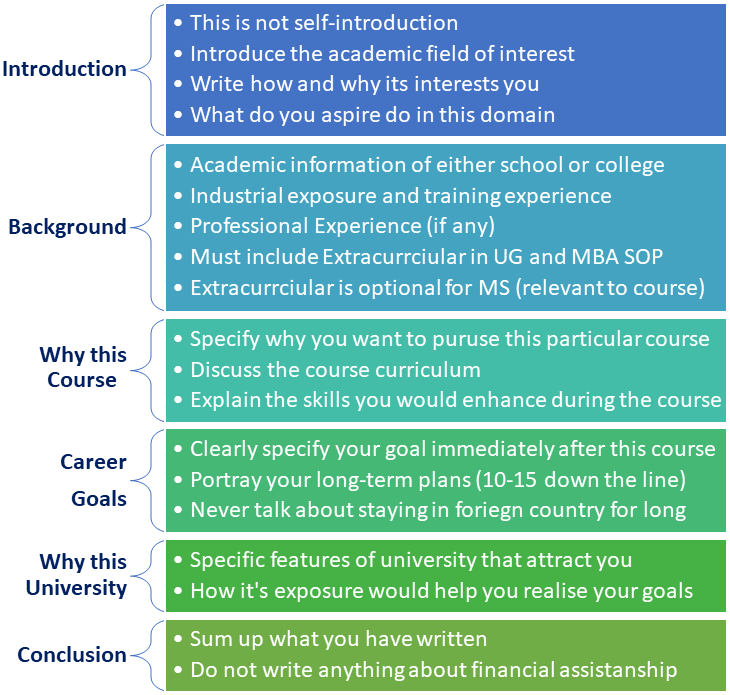
Structure for SOP (Statement of Purpose)
While framing an SOP structure, students must:
- Introduce yourself and your objectives.
- Explain why you are interested in the field for which you are applying and what drives you. Summarize your undergraduate and graduate education. Include any pertinent academic accomplishments, research experience, honours, or publications.
- Describe your long-term and short-term academic and professional objectives. What do you want to gain from this programme, and how does it fit into your long-term career goals?
- Explain why you chose this programme in particular.
- What are your motivations for choosing this university, and how will the programme assist you in achieving your objectives?
- Emphasize your accomplishments and strengths and how they relate to the programme you’re applying to. Describe any abilities or experiences that distinguish you as a unique and valuable candidate.
- Summarize your mission statement.
Let us discuss each point in detail.
1) SOP Paragraph 1: INTRODUCTION AND STATEMENT OF GOALS
Use this space to talk about your goal in life. You can be creative here and use analogies or quotes to make it more interesting. But, don’t waste a lot of space in introducing your goal. The sooner you lay it out, the better it is. Remember, it is an essay about your goals in life…so starting with it is always a good idea. It is not very unlike a goals essay asked from MBA aspirants.
2) SOP Paragraphs 2 & 3: CAREER PROGRESSION
This is the paragraph that you usually use to talk about yourself. You can start with a brief history about yourself and your career progression starting from your school to your college. This is the paragraph that is usually dedicated to your academic pursuits. If you have work experience, you can limit your school life and talk more about your college in the second paragraph and move to work experience in the third paragraph. If not and you are applying directly after your graduation or school, then you can divide para 2 for academics and para 3 for co-curricular. You can take a hint on how to write about your career progression.
3) SOP Paragraph 4: WHY?
This is the most important part of your Statement of Purpose for this is the place where you provide the reason as to why you wish to do what you wish to do. You can make it more interesting by narrating an incident that leads you to the decision or a turning point in your life. The more emphatic and passionate you are in this paragraph, the better your essay. For instance, if we talk of an SOP for a Master’s in Economics; you must be clear about why you wish to pursue Economics and what you wish to achieve from that degree.
4) SOP Paragraph 5: HOW DO YOU PLAN TO ACHIEVE YOUR GOAL?
You are finally ending your essay. So far you have talked about what you want to do, what lead you to that decision, and why you are moving toward this course. Now, lay down how you plan to achieve your goals. If you wish to get into research, write it. If you plan to work for a certain organization, write it. This goes on to show how well you have thought your life over. Also, give it time periods…for instance, I intend to work in the industry for two years before I start my research program.
Check out the Common Mistakes to Avoid in an SOP.
NOTE: It is not mandatory to present the information in the manner suggested in this sample SOP format. This is only one of many possible ways in which you can present your statement of purpose. No matter how you wish to narrate the story, just remember, it should come together and be cohesive.
Sample of Statement of Purpose for MS, UG, MBA, PhD, and Countries
SOP Format for MS, MBA, UG, and PhD: Understanding what to include and what not to include is all very well. What is of utmost importance is getting the format right. Like all professional documents, SOP also has a standard format that is followed by general universities. It is important to note that irrespective of whether you are writing the statement of purpose for an MBA program, an MS program, or even for any of the UG Courses, the format essentially would remain the same. This article takes note of the same.
We have a few statements of purpose examples based on various study abroad programmes such as MS, MBA, UG, and PhD.
SOP Sample for MS
Given below are some Sample SOPs for MS (Master’s degree), which were accepted in popular schools abroad. See how an MS SOP is written and also refer to various samples for different engineering courses:
An SOP can be written with different approaches. You may check out the samples on: | |
|---|---|
SOP Sample for MBA
Writing a Statement of Purpose for MBA is slightly different than writing an MS SOP. Rather than sounding a geek, you would need to sound more of an all-rounder. Check out the writing style for MBA SOP and SOP Sample for MBA. You may also want to refer to SOP writing for Master in Management (MIM).
SOP Sample for UG
A UG SOP differs from a master’s SOP, as it has little to no work experience and no information on a bachelor’s degree with project information. Here, students need to mention more about their extracurricular activities. Their participation in quizzes, science competitions, and sports carries a lot of weight. Check out how to go about a bachelor’s SOP and a UG SOP Sample.
SOP Sample for PhD
A PhD SOP is a lot different than the rest of the programmes. Understand the importance of and how to write a PhD SOP here.
SOP Sample for USA, Canada, UK, and Australia
You might be wondering what differs in the SOPs with the change in the country. It is important to note that the format of SOP remains the same for every country unless there is some specific requirement given by any university. If you still wonder what the Sample SOPs for different look like you may refer to the sample SOPs in popular countries:
| Sample SOP for the USA | Sample SOP for Canada |
| Sample SOP for UK | Sample SOP for Australia |
SOP Important Points
The most important points that you often end up missing in SOPs are as follows:
- Career Goals: Writing just that you have a childhood inclination toward a certain field would not make your SOP any stronger. You should always be able to explain what you aim to do in life by gaining knowledge in that field.
- How the University would help in achieving them: Why do you want to join a particular university and how it would help in obtaining your career goals both are equally important. Writing that you are interested in joining a university abroad due to its location or infrastructure would not help.
Do’s and Don’ts of a Statement of Purpose
It is certain that your SOP should sound interesting and convincing yet it is not acceptable that you lie to make it interesting. Likewise, you would definitely want to take help from the samples available over the internet but, at the same time, you need to ensure that your SOP is not copied from anywhere. Giving little to no emphasis on facts and figures would downsize the quality of your drafts meanwhile providing a lot of information is also not a good idea.
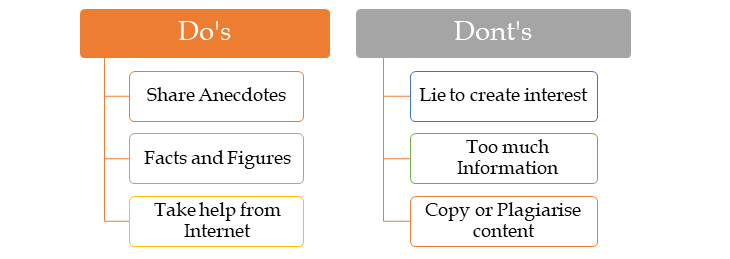
We tend to make some mistakes that should be avoided while writing SOPs that are going abroad for review. Check out the Common Mistakes to Avoid in an SOP.
If you seek guidance related to abroad university application process, you may register with Shiksha Study Abroad and avail of our expert counselling services. As a bonus, we offer editorial services ranging from SOPs and University Essays to Academic CVs and Academic and Professional LORs editing.
Purpose of SOP: The purpose of the SOP is to indicate strong research interest and your potential for advanced research. It will consist of your motivational story; education; projects -academic and professional- to show your expertise in the subject; why you want to pursue the degree now; short and long-term goals; why this University and lastly why you are a good fit for the school. Please note that the SOP should be written in a REVERSE CHRONOLOGICAL order (Present to Past).
Students need to consider the following SOP Format
1) Statement of Purpose Introduction
It is advised to start your SOP with an anecdote (of an account) that inspired you to take up the particular course. The introduction should not consist of any generic information rather it is advisable to talk about any specific instance that motivated you to pursue this course. Make sure this instance is from your recent past (as the university would like to know about your recent accomplishments).
Please give a specific instance or event that can showcase your interest in the MS. You may talk of a recent research paper that you have read or a project that you undertook.
As an overview, you may include the following points in your SOP introduction:
- An inspiring quotation.
- Reasons to pursue a particular course.
- Any research project or significant skill that influenced your decision to select this course.
- You may also provide a brief overview of yourself and your background with respect to your motivation for applying for a particular course.
2) Statement of Purpose Academic Background
Begin this para with the name of your college/ school, location, year of enrolment, year of completion, course name, and subjects studied. Mention the subjects that you feel you have a stronghold or knowledge in. Also, include major projects that you have undertaken along with the timelines (Month/ Year), and a brief description of your learning experience through these projects. This should follow up with any Industrial visits, Internships, training, Seminars, workshops, symposiums, and the like.
3) Statement of Purpose Professional Experience (if any)
Start this para with the name of the present organization, with details of the date of joining, location, designation and a brief description of your profile/ Job responsibilities. If possible mention any major project that you were involved in, focusing on your particular role. Next, you can write about your previous job in the same manner as stated above.
You may also mention certain challenges that you faced while working and how you overcame those challenges. Please note that everyone faces difficulties and challenges; what matters the most is how you overcome them.
4) Why Masters and Why Now?
This paragraph includes information about your reason for pursuing Masters, also the skills that you would like to inculcate and enhance through this course. You must mention your reasons with valid examples or substantial information. Also, you need to state WHY THIS IS THE PERFECT TIME for you to pursue your master’s. If you have professional experience provide your reasons why you are leaving the job to pursue this course.
- What skills or knowledge are you planning to enhance through this course?
- How will it help to achieve your goals?
- What are your goals?
- Short-term: what are you planning to do just after your masters?
- Long-term: in the long run, where do you see yourself?
5) Statement of Purpose Career Goals
This is the Most Important Part of your SOP. The University focuses a lot on this paragraph as it reflects that you are focused on your career and you have planned each step thoroughly. Please note that this paragraph needs to be divided into two parts, Short-term, and Long-term Goals, and should comprise specific information, nothing generic.
- Short-Term Goals (0-5 years after completion of course): This paragraph should provide details regarding your plans soon after completing your Master’s degree. You need to describe the job profile you are interested in along with the companies and the department you would like to work in. This should follow the Job responsibility that you are expected to undertake and perform.
- Long-Term Goals (10-15 years after completion of the course): This paragraph should elucidate your plans after completion of the course within 10-15 years. Please specify how this short-term goal will lead to your long-term goal. Please note, if you have research plans do specify a few details about the research work you would like to work, details of where would you like to do the research along with some important work done in this particular field. End this paragraph with how pursuing a master’s will help you to accomplish these goals.
6) Why this particular University?
Mention a good reason that would justify you pursuing this course at this University. Mention some specific features of the university that suit your requirements. Add names of any faculty and their research areas in this program (give names), research labs/centres, clubs, activities, subjects in the curriculum/electives, and also the scope of these in enhancing your profile. To give these details you need to visit the university and program website.
Please visit the university’s website and talk about a few subjects in the curriculum. Also, mention the names of 1 or 2 professors and their area of research that interests you.
7) Statement of Purpose Extracurricular Activities
Keep the following details in mind when writing this paragraph; participated in any event, played any sport, associated with any NGO work, any club, any independent project work done, etc. (Mention apart from academics what you have done). State how these activities that you have participated in in your college will help you or prepare you for extracurricular activities at this University.
How have these activities shaped you as a person and how can you contribute to the university with these experiences/ interests?
8) Conclusion
Very crisply at the end mention how you are prepared for this particular degree and why they should take you. An essay’s main ideas should be recapped in the statement of purpose conclusion. Also, it must succinctly and forcefully reiterate the thesis, providing the reader with a strong sense of the applicant’s qualifications.